


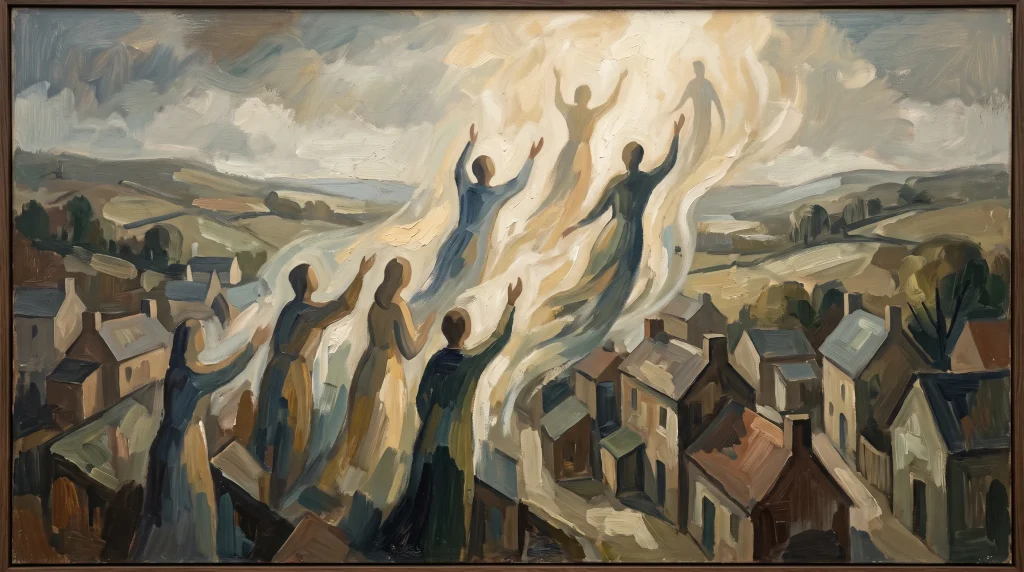
A race is underway to keep a foundational work of British Modernism within the country after the government placed a temporary export bar on a rare painting by Sir Stanley Spencer. The move, intended to allow UK institutions or private donors the opportunity to purchase the artwork, follows a formal recommendation that the piece is of outstanding significance to the study of the artist’s development.
The 1915 painting, titled “The Resurrection of the Good and the Bad,” has been valued at £450,000. Interested parties have until December 10, 2026, to submit a serious expression of interest to purchase the work at this recommended price and prevent it from being sold abroad.

Historical and Artistic Significance
Created just before Spencer’s service in the First World War, the painting is a diptych—a two-panel work—measuring approximately 80 x 63 cm per panel. Art historians regard it as a pivotal moment in the artist’s career, marking his first major exploration of the “resurrection” theme. This concept would later become the defining motif of his life’s work, most notably in his large-scale masterpiece “The Resurrection, Cookham,” which is now held by the Tate.
The official government notice details how the work captures Spencer’s unique vision of his home village of Cookham as a site of spiritual awakening. Unlike his later, more populated scenes, this 1915 diptych offers a direct look at the genesis of his stylistic and theological ideas before they were altered by the trauma of his experiences during the war.
The Export Block Process
The decision to block the export was made by Arts Minister Ruth Mackenzie, acting on the advice of the Reviewing Committee on the Export of Works of Art and Objects of Cultural Interest (RCEWA). The committee applied what is known as the “third Waverley criterion,” which identifies objects of outstanding significance for the study of a particular branch of art, learning, or history.
According to RCEWA experts, the painting provides essential context for Spencer’s early artistic influences and the evolution of British Modernism. As a diptych, it represents a specific technical challenge and narrative structure that is relatively uncommon in his later portfolio, making it a critical asset for researchers and the public alike.
The initial deferral period is set to end on December 10, 2026. If a serious bid or expression of interest is made by a UK-based purchaser by that time, the export bar may be extended for an additional four months to allow the potential buyer to secure the necessary funding. If no intervention occurs by the deadline, an export license will likely be granted, allowing the painting to leave the country permanently.