


- Legal Compliance: The UK legal minimum tread depth is 1.6mm, but safety bodies recommend replacing tyres at 3mm to maintain braking performance.
- Service Differences: While mobile fitting offers convenience, most mobile units cannot perform four-wheel alignment due to the need for specialist heavy-duty ramp equipment.
Choosing Between Mobile and Garage Tyre Fitting: A Guide for UK Motorists
For motorists across the United Kingdom, the maintenance of vehicle tyres is a matter of both safety and legal necessity. When the time comes for replacement, the choice between a traditional garage visit and a mobile fitting service often depends on the specific needs of the vehicle and the schedule of the driver. Understanding the technical limitations and the legal framework is essential for making an informed decision.
The Practicality of Mobile Tyre Fitting
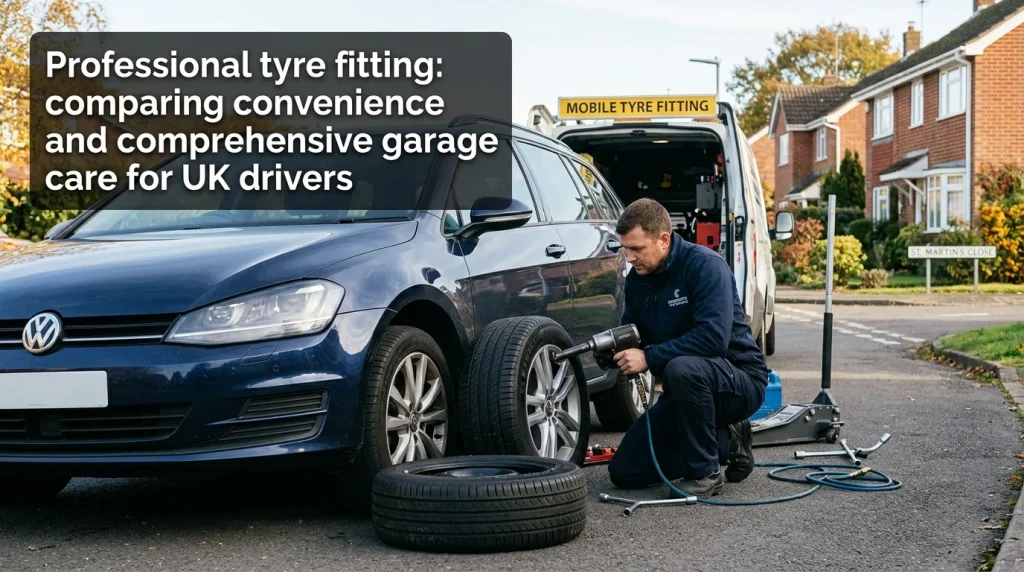
Mobile tyre fitting has seen a rise in popularity due to the convenience of having a technician arrive at a home or workplace. These services are generally well-equipped to handle standard tyre replacements and wheel balancing. However, there are technical boundaries to what can be achieved on a driveway or in a car park. Most mobile tyre fitting services cannot perform four-wheel alignment, also known as tracking, as this process requires specialist heavy-duty ramp equipment and calibrated sensors that are permanently installed in a workshop.
The Importance of Garage-Based Specialised Equipment
While mobile units offer flexibility, a traditional garage remains the primary location for comprehensive steering and suspension checks. If a vehicle is experiencing uneven tyre wear, a garage-based alignment service is often required to correct the underlying mechanical issues. When comparing costs, drivers should look for a “fully-fitted” price. According to industry standards, this typically includes the tyre, fitting, wheel balancing, a new valve, and the fees associated with old tyre disposal.
Legal Requirements and Safety Benchmarks
The legal stakes for tyre maintenance in the UK are high. Official DVSA guidelines state that the minimum legal tyre tread depth is 1.6mm across the central three-quarters of the tread around the entire circumference. Driving on tyres that do not meet this standard is a serious offence; it can result in a fine of up to £2,500 and three penalty points per tyre. Therefore, a vehicle with four illegal tyres could lead to a £10,000 fine and the immediate loss of a driving licence.
Safety organisations, including TyreSafe, suggest that motorists should not wait for the legal limit to take action. They recommend replacing tyres when the tread reaches 3mm to maintain effective wet-weather braking performance. As tread depth decreases, the tyre’s ability to disperse water is reduced, significantly increasing stopping distances on wet roads.
Verifying Tyre Quality and Age
Consumers can evaluate the performance of new tyres by examining UK tyre labels, which provide standardised ratings for fuel efficiency, wet grip, and external rolling noise. Furthermore, it is possible to verify the age of a tyre by checking the four-digit DOT code on the sidewall. In this code, the first two digits represent the week of manufacture, while the last two digits indicate the year. Regularly checking these details is a vital part of the responsibility to check your tyres for safety and legality, ensuring the vehicle remains roadworthy regardless of the chosen fitting method.