


The UK’s top military commanders have issued a series of stark warnings regarding national security, suggesting the country faces its most dangerous environment since the Cold War. However, new government data suggests that while the rhetoric from Whitehall is sharpening, half of the British public feels psychologically and practically unprepared for a major crisis.
Air Chief Marshal Sir Richard Knighton, Chief of the Defence Staff, stated on 16 September 2026 that the risks currently facing the UK are greater than at any point in his 35-year military career. His assessment follows similar comments from General Sir Roly Walker, who has indicated the British Army must be ready for potential conflict by 2027.
Despite these high-level warnings, the 2026 UK Public Survey of Risk Perception, released this month, revealed a significant gap in civilian readiness. According to the data, 50% of households feel “slightly or not at all prepared” for major emergencies.


What the “Prepare” guidance actually says
In response to the shifting security landscape, the government is moving toward a “whole-of-society” approach to resilience, as mandated by the 2025 Strategic Defence Review. This strategy encourages citizens to take basic steps to ensure they can look after themselves and their neighbours during disruptions to power, water, or communication networks.
Official guidance hosted on the government’s “Prepare” website recommends that households maintain an emergency kit. This is not a directive to “stockpile for war”—a claim that circulated falsely on social media in mid-September—but rather a standard precaution for various hazards, including floods, cyber-attacks, or prolonged power cuts.
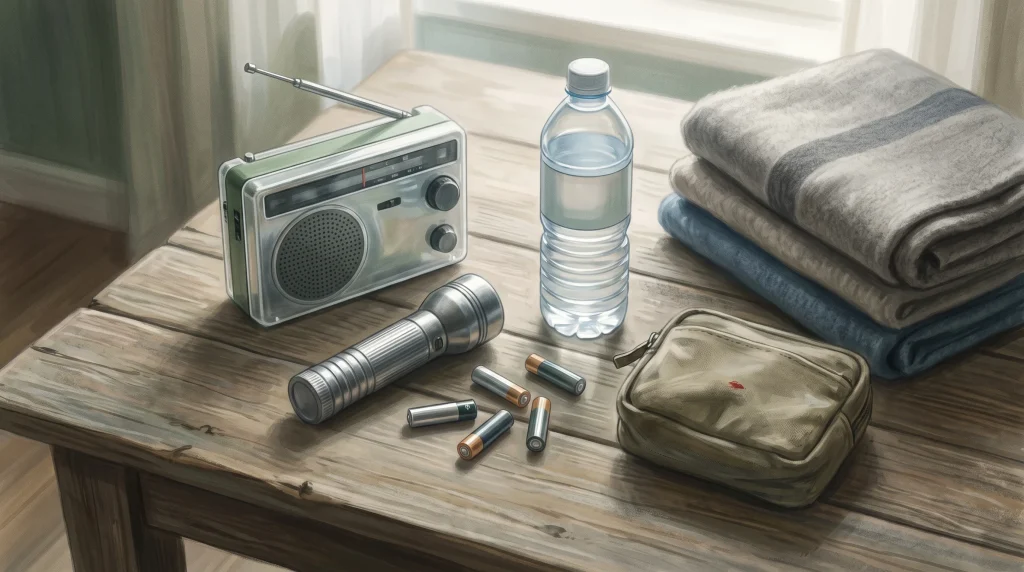
Recommended items for a household emergency kit include:
- A battery-powered or wind-up radio to receive official updates if the internet fails.
- A torch with spare batteries.
- A first aid kit and essential medication.
- Bottled water: The guidance suggests a minimum of 2.5 to 3 litres of drinking water per person, per day.
Officials also encourage those with additional needs, such as the elderly or those with medical conditions, to sign up for the Priority Service Register (PSR) with their energy and water suppliers.
Policy shifts and future exercises
The focus on national resilience is being formalised through the Resilience Action Plan 2026 Implementation Report, which confirms that a national public awareness campaign will launch before the end of the year.
Behind the scenes, the government is reportedly updating its “War Books”—the classified crisis response manuals that outline how the state should function during a national emergency.
To test these evolving plans, the government has scheduled Exercise ALBISTON SHADOW for 2027. It is expected to be the largest home defence exercise in decades, designed to coordinate the response between the military, emergency services, and local authorities.
Addressing public concerns
While the language used by military chiefs is increasingly urgent, officials have sought to clarify the nature of the threat. The current focus is primarily on “sub-threshold” attacks—such as cyber-disruption to the National Grid or interference with global supply chains—rather than a literal threat of conventional invasion.
Crucially, despite the emphasis on readiness and the “Total Defence” model used by some Nordic nations, the Ministry of Defence has stated there are currently no plans for the return of conscription. The strategy remains focused on a professional military supported by a resilient and well-informed civilian population.
A national resilience campaign is expected to be rolled out across the UK in the coming months to address the 50% of the population who currently feel unprepared for the risks outlined by the Chief of the Defence Staff.