


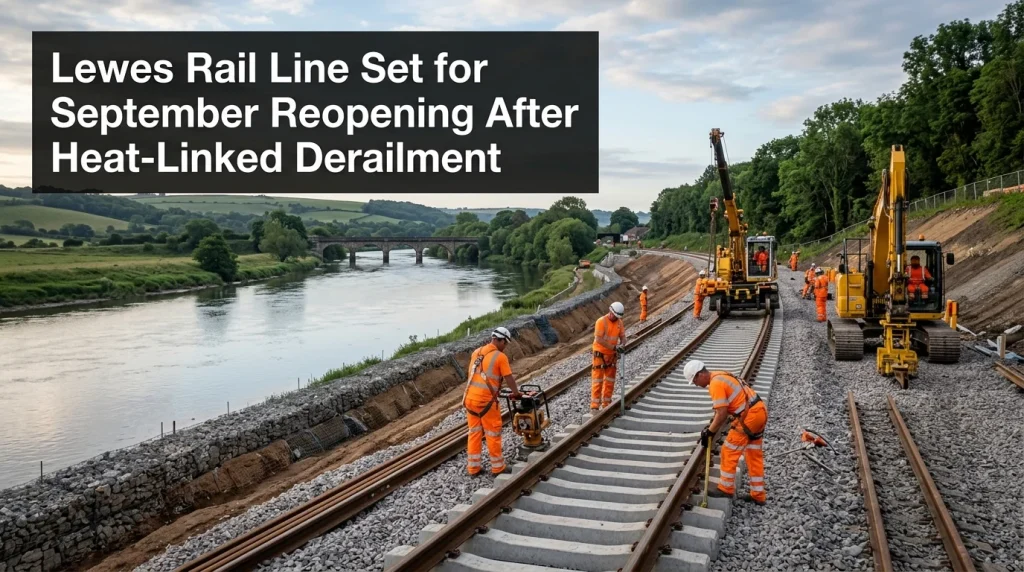
- Service Restoration: The railway line between Haywards Heath and Lewes is scheduled to reopen fully on 1 September 2026, following extensive repairs.
- Investigation Findings: Rail authorities have identified a buckled rail and track geometry irregularities as the primary factors in the derailment, which occurred during record-breaking heat.
Railway Reopening Scheduled Following Major Engineering Effort
The railway line between Haywards Heath and Lewes is on course to reopen to passenger services on 1 September 2026. This confirmation follows a period of intense recovery and repair work required after a significant derailment earlier this month. Network Rail staff and specialist contractors have been working around the clock to restore the infrastructure near the River Ouse, ensuring the track meets all safety requirements before the resumption of the Southern Railway travel schedule.
The incident occurred on 13 August 2026, which was recorded as the UK’s hottest day of the year. During the afternoon heat, the rear three carriages of an eight-carriage Southern passenger train (service 1F34) derailed while travelling from London Victoria to Eastbourne. The derailment resulted in 30 people being injured, with 20 of those requiring treatment at local hospitals. Two individuals sustained serious injuries in the crash, though their current conditions have not been further detailed by medical staff.
Investigation Into Track Geometry and Heat Impact
In the wake of the derailment, the Rail Accident Investigation Branch (RAIB) launched an immediate inquiry into the causes of the accident. An interim report released by the branch identified a “track geometry irregularity” at the site. Furthermore, the report pointed to a potentially buckled rail, an issue often linked to extreme thermal expansion during periods of high atmospheric temperature.
This incident follows a series of regional infrastructure challenges, including recent train service disruption following a track defect on the Oxted line. Engineers have been closely monitoring the Sussex route to identify similar vulnerabilities, particularly in areas where clay-based embankments may be susceptible to movement during extreme weather cycles.
Recovery and Infrastructure Repair
The recovery operation was described by officials as technically demanding due to the location of the derailment on a clay-based embankment near the River Ouse. To remove the overturned carriages, Network Rail updates confirmed that two large specialist cranes were deployed to the site. These machines were used to lift the damaged rolling stock onto flatbed wagons for transport away from the scene for detailed analysis.
Engineers have completed approximately 5,000 hours of repair work to date. This extensive programme included not only the replacement of the damaged rails but also significant stabilisation of the underlying embankment and the recalibration of signalling systems. As the 1 September reopening date approaches, final safety inspections and test trains are expected to run across the affected section to check the safety of the new track layout. Commuters are advised to check the latest timetables as the service returns to its standard timetable.