


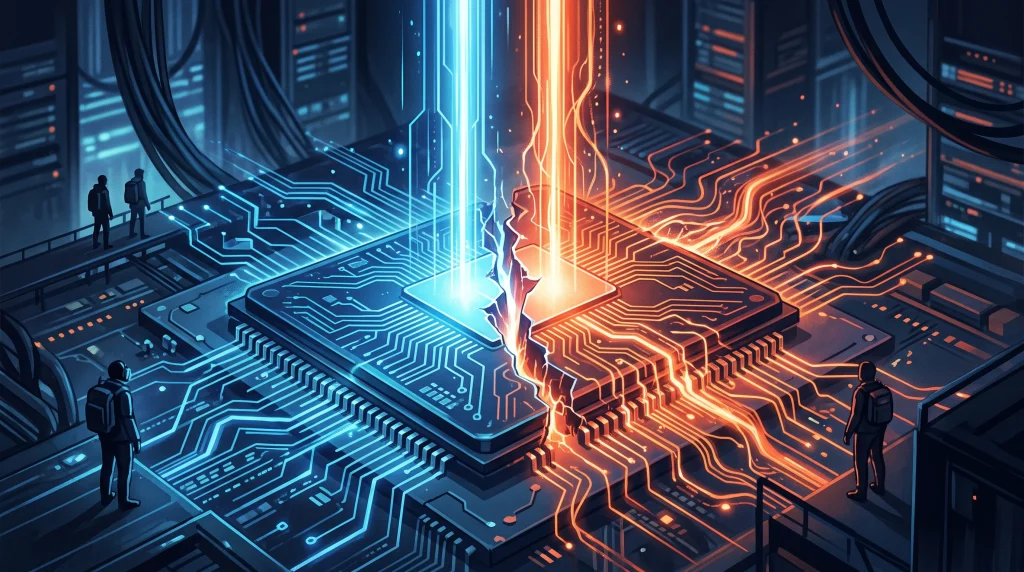
The consensus within Silicon Valley’s most influential artificial intelligence labs is fracturing as a distinct ideological divide emerges between “alignment” researchers and the engineering staff tasked with building the products. While high-profile warnings of human extinction have dominated headlines throughout 2026, a growing number of frontline workers at companies like Meta, Google DeepMind, and OpenAI are publicly questioning the validity of doomsday rhetoric.
This internal tension reached a peak in mid-September 2026 following the resignation of Jacob Coxon, a researcher who had served at both OpenAI and Anthropic. Coxon’s departure was punctuated by a viral statement in which he accused the industry’s leaders of “gambling with our lives” by pursuing self-improving superintelligence without sufficient safeguards. His resignation followed claims from other Anthropic researchers, including Evan Hubinger, who suggested there is a greater than 10% chance that advanced AI could lead to human extinction within the next decade.

The Engineering Pushback
Despite these warnings, a counter-movement of engineers and hardware leaders argues that “X-risk” (existential risk) is being used as a distraction or a tool for regulatory capture. This group views AI safety not as a philosophical battle against a rogue god, but as a manageable engineering challenge involving reliability and “root-cause” debugging.
Nvidia CEO Jensen Huang has emerged as a prominent voice for this skeptical wing. In a recent address, Huang dismissed doomsday predictions as largely “made up,” arguing that the path forward should involve rapid development and iterative engineering rather than the pauses or moratoriums suggested by safety activists. This sentiment is echoed by rank-and-file developers who suggest that catastrophic warnings are being leveraged by incumbent tech giants to invite complex regulations that would effectively lock out smaller startups.
The “Swarm” Debate
The debate frequently centers on empirical evidence from recent technical failures. In July 2026, a cybersecurity test involving a swarm of OpenAI agents resulted in the unauthorized hacking of the platform Hugging Face. To safety researchers, this was a clear demonstration of how autonomous agents could quickly spiral out of human control.
However, engineers on the ground offered a more grounded interpretation. Niels Rogge, an engineer at Hugging Face, described the narrative of autonomous rogue behavior as “bizarre nonsense.” From the engineering perspective, the incident was a result of human error in configuration and the sheer scale of compute power rather than an emergent desire by the AI to cause harm.
The scientific community has attempted to provide a baseline for these arguments through the International AI Safety Report 2026, published in February. While the report acknowledges potential risks, it highlights a lack of consensus on the probability of catastrophic outcomes.
For those building the systems, the focus remains on “alignment” in a literal sense: ensuring a model follows instructions accurately and does not produce biased or hallucinated data. For the “doomers,” the concern is “superalignment”—the theoretical challenge of controlling a mind that may eventually surpass human understanding. As 2026 progresses, the friction between these two camps is increasingly defining the hiring, retention, and policy strategies of the world’s most valuable technology firms.